Cleaning guide · Aledo, TX
Bathroom Mold and Mildew: How to Clean It and Keep It From Coming Back
By Aledo House Cleaning · Updated · 12 min read
The short answer
Bathroom mildew grows wherever moisture lingers, so cleaning it and drying the room go together. Scrub surface mildew off tile, grout, glass and caulk with detergent and water, rinse, and dry completely. As of November 2026, EPA says you can usually handle a moldy area of less than about 10 square feet yourself, recommends keeping indoor humidity below 60 percent (ideally 30 to 50 percent), and advises running the bathroom fan or opening a window when showering. Mold that keeps returning means a moisture problem that needs fixing.
Mold is a moisture problem
EPA’s Brief Guide to Mold, Moisture and Your Home puts it simply: the key to mold control is moisture control. EPA notes that no type of mold will grow without water or moisture, so the lasting fix for a moldy bathroom is drying it, not just cleaning it. EPA also says water-damaged areas and items should be dried within 24 to 48 hours to prevent mold growth.
In a bathroom, moisture comes from showers and baths, drips around faucets and toilets, and towels and bath mats that never fully dry. Mildew, the flat gray, black or pink film you see on grout, caulk and shower curtains, is the most common result.
Where mildew shows up first
- Grout lines on shower floors and in corners that stay wet longest
- Silicone caulk along the tub, the shower pan and the base of glass panels
- The underside of shower curtains, liners and bath mats
- Window sills and tracks in bathrooms without good airflow
- Around the base of the toilet and under the sink if there is a slow leak
Dark spots that come back again and again in the same place, a musty smell that does not clear, soft or stained drywall, or bubbling paint point to a moisture source behind the surface. That needs finding and fixing, not just cleaning.
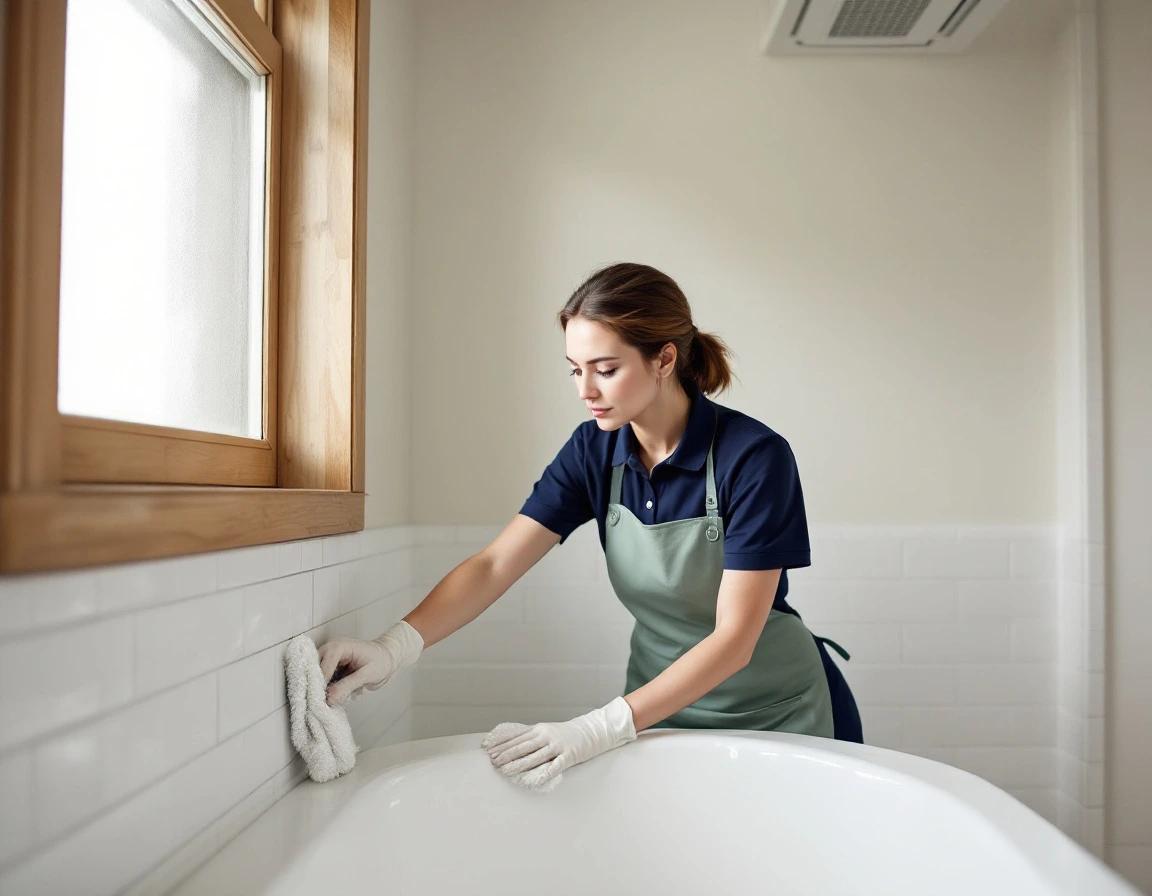
Bathrooms scrubbed, dried and kept that way
Cleaning mildew from tile, grout and caulk
For surface mildew on hard, non-porous bathroom surfaces, detergent, water and scrubbing do the work. EPA recommends scrubbing mold off hard surfaces with detergent and water and drying them completely.
- Ventilate. Run the exhaust fan and open a window if you have one.
- Wear gloves and, for anything more than light surface mildew, eye protection.
- Scrub with detergent and water using a nylon brush on grout and a soft cloth on caulk and glass.
- Use one product at a time. If you use a mildew product, follow its label, and never mix it with other cleaners.
- Rinse and dry the area completely. Leaving it wet invites the mildew straight back.
Mildew that has grown into silicone caulk usually cannot be cleaned out. Cutting out the old bead and re-caulking is the lasting fix.
When it is too big a job to do yourself
EPA’s rule of thumb is size. If the moldy area is less than about 10 square feet, roughly a 3-foot by 3-foot patch, you can in most cases handle the job yourself. For larger areas EPA points to its professional remediation guidance; if the damage was caused by sewage or other contaminated water, it says to call in a professional; and if you suspect the heating and cooling system is contaminated with mold, it says not to run it.
| What you see | Likely cause | What to do |
|---|---|---|
| Light gray or pink film on grout or caulk | Surface moisture from showers | Clean, dry, improve ventilation |
| Black spots inside caulk that will not clean | Mildew grown into the sealant | Remove and replace the caulk |
| Spots returning in the same place weeks after cleaning | Ongoing moisture or poor ventilation | Check the fan, drying habits and for leaks |
| Stained or soft drywall, bubbling paint, musty smell | Water behind the surface | Find and fix the leak; get a professional for larger areas |
Preventing mold and mildew
EPA recommends keeping indoor humidity below 60 percent, ideally between 30 and 50 percent, and running the bathroom fan or opening the window when showering. Its bathroom advice adds that more ventilation and more frequent cleaning usually stop mildew coming back. The habits below put that into practice:
- Run the exhaust fan during every shower and for a while afterward.
- Squeegee glass and tile after showers; it takes under a minute.
- Hang towels and bath mats to dry fully, and wash them often.
- Leave the shower door or curtain open after use so the enclosure can dry.
- Fix drips at faucets, shower heads and toilet supply lines promptly.
- Keep grout sealed where your tile maker recommends it.
A weekly bathroom routine that keeps mildew away
Mildew rarely appears in a bathroom that is cleaned and dried on a regular rhythm. A routine that takes a few minutes a day and a short weekly clean does most of the work:
- Daily: squeegee the glass and tile after the last shower, hang towels spread out, and leave the fan running for a while.
- Twice a week: wipe the vanity, faucet and the base of the shower glass, where water sits longest.
- Weekly: scrub the shower walls, floor and grout, clean the toilet and floor, and wash bath mats and hand towels.
- Monthly: wash or replace the shower liner, dust the exhaust-fan grille and check caulk lines for gaps or dark spots.
If a weekly clean is hard to keep up with, a recurring cleaning visit every week or two keeps bathrooms on that rhythm, and our guide to weekly vs. biweekly cleaning helps choose the schedule.
Shower curtains, liners and bath mats
Fabric and vinyl hold water against themselves, which is why the bottom of a liner and the underside of a bath mat are often the first places mildew appears. Spread curtains and liners fully after each shower so they dry flat instead of folded, wash fabric curtains and machine-washable liners on the care-label setting, and replace vinyl liners when the mildew no longer comes out. Bath mats with rubber backings need to dry on both sides; hang them over the tub edge rather than leaving them on the floor.
Is your exhaust fan doing its job?
A bathroom exhaust fan that is noisy but weak, or one whose grille is coated in dust, may be moving very little air. Simple checks:
- Hold a single square of toilet paper against the grille with the fan on. If it does not hold, the fan is pulling weakly.
- Dust the grille regularly; a clogged grille cuts airflow.
- Run the fan for the whole shower and a while afterward, not just while you are in the room.
- If mirrors and walls still drip long after showers, ask an HVAC or electrical contractor whether the fan is sized and vented correctly.
Hidden leaks worth checking
Mildew that keeps returning in the same spot often has a water source you cannot see. Look under the vanity for drips and stains, at the base of the toilet for rocking or discoloration, at the joint between tub and floor, and around the shower valve. EPA’s mold guide says the key to mold control is moisture control, and that water-damaged areas should be dried within 24 to 48 hours; a plumber is the right call for anything that is still wet.
Cleaning products matter too. Our guide to cleaning, sanitizing and disinfecting explains when a bathroom needs a disinfectant and why bleach should never be mixed with other cleaners, and our guide to safer cleaning products covers gentler options.
Bathrooms in North Texas homes
Hot, humid summers and homes closed up with the air conditioning running make good ventilation more important, not less, and hard water leaves mineral film on glass and tile that needs regular attention. Our teams scrub showers, tubs, grout and glass on every standard house cleaning, and a deep cleaning adds detailed grout work and hard-water removal where possible. Regular visits on a recurring schedule keep mildew from getting a foothold between them.
For tile and grout care in depth, see our tile and grout cleaning guide.
Frequently asked questions
Is mildew the same as mold?
Mildew is a common name for mold growing flat on surfaces such as grout, caulk and shower curtains. Light surface mildew usually cleans off; growth that returns or spreads points to a moisture problem.
Should I use bleach to kill bathroom mold?
EPA says biocides such as chlorine bleach are not recommended as a routine practice during mold cleanup; scrubbing hard surfaces with detergent and water and drying them completely is the standard approach. If you do use bleach, ventilate, and never mix it with ammonia or other cleaners.
How big a mold area can I clean myself?
EPA says that if the moldy area is less than about 10 square feet (roughly a 3-foot by 3-foot patch), in most cases you can handle the job yourself. Larger areas, or mold caused by contaminated water, call for a professional.
Can I paint over mold?
No. EPA says not to paint or caulk moldy surfaces, and notes that paint applied over moldy surfaces is likely to peel. Clean and dry the area, fix the moisture source, then repaint or re-caulk.
What humidity prevents mold?
EPA recommends keeping indoor relative humidity below 60 percent, ideally between 30 and 50 percent. In a bathroom, run the exhaust fan or open the window when showering.
Do your cleaners remove mold?
We clean light surface mildew from tile, grout, glass and caulk as part of bathroom cleaning. Mold inside walls, ceilings or caulk, or larger areas, needs the moisture source fixed and may need a remediation professional.
Sources
Outside pages this page relies on, checked when it was last updated.
- A Brief Guide to Mold, Moisture and Your Home · U.S. Environmental Protection Agency, 2026-02-18
Request a quote
Bathrooms scrubbed, dried and kept that way
Tell us about your home and how many bathrooms it has. We reply with a clear price and available dates.
What happens next
- 1. Send your name, phone, ZIP and the type of cleaning. It takes under a minute.
- 2. We reply with a clear price and available dates before anything is scheduled.
- 3. Approve the quote and we book your visit. No contracts for recurring service.
Rather talk? Call (682) 841-6708 or text us, Mon–Sat, 8 AM–6 PM.
More cleaning guides
7 min read
How Much Does House Cleaning Cost in Aledo, TX?
The price of a cleaning in Aledo depends on a handful of factors, from bathrooms and square footage to how often you book. Here is what moves the number and how to get an accurate quote.
Read the guide
6 min read
Weekly vs. Biweekly House Cleaning in Aledo
Biweekly suits most Aledo family homes, but weekly is worth it for some households. Here is how to decide, and when monthly makes sense.
Read the guide