Cleaning guide · Aledo, TX
Cleaning High Ceilings, Ceiling Fans and Chandeliers Safely
By Aledo House Cleaning · Updated · 11 min read
The short answer
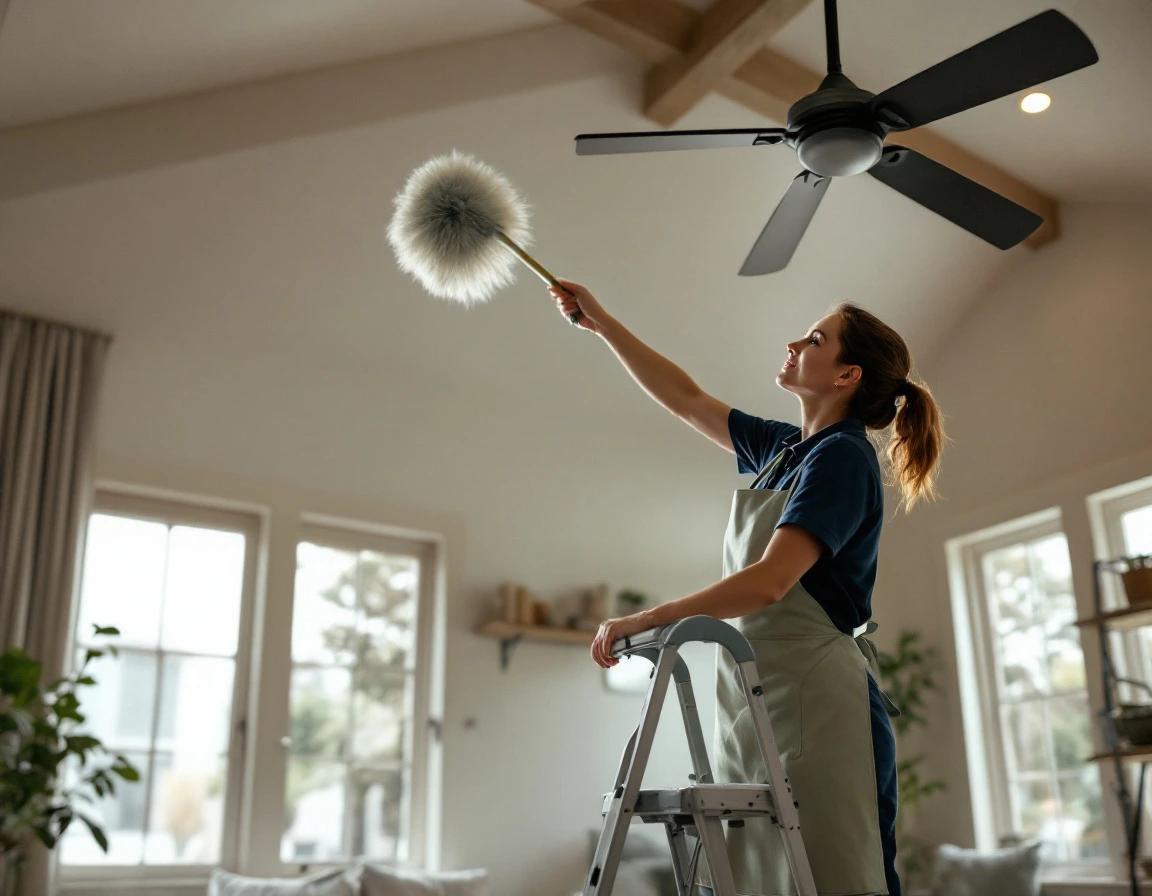
Clean high places first, before anything below them: ceiling fans, vent covers, light fixtures, ledges and the tops of door frames, so falling dust lands on surfaces you have not cleaned yet. Use extension poles and fan dusters to stay on the floor wherever you can, a sturdy step ladder only within its rated height, and leave two-story foyers and large chandeliers to someone with the right equipment. As of November 2026, the CPSC’s latest report estimates 273,000 emergency-department-treated injuries involving ladders and stools in 2024, so staying on the floor is worth the extra tool.
Always work from the top down
Dust falls. Cleaning a ceiling fan after the coffee table and floor means doing them twice. Professional cleaners work in a fixed order in every room: high dusting first, then surfaces at eye level, then furniture, and floors last.
- Ceiling fans, light fixtures and chandeliers
- Vent covers, return-air grilles and smoke-detector housings (dust only; do not spray)
- Crown molding, high ledges, plant shelves and the tops of door and window frames
- Picture frames, mirrors, shelves and blinds
- Furniture, counters and baseboards
- Floors, vacuumed and then mopped
Tools that keep you off tall ladders
| Tool | Best for | Notes |
|---|---|---|
| Extension pole with a microfiber duster | Ledges, crown molding, high shelves | Microfiber traps dust instead of spreading it |
| Curved ceiling-fan duster on a pole | Fan blades up to the pole’s reach | Slides over each blade and holds the dust |
| Vacuum with a soft brush and extension wand | Vent covers and return grilles | Pulls dust in rather than knocking it down |
| Pillowcase method | Fan blades you can reach from a step ladder | Slip the case over a blade and pull back; the dust stays inside |
| Sturdy step ladder | Fixtures within its rated reach | Never on the top step or top cap |
Fans, fixtures and ledges dusted from the top down
Ceiling fans
Turn the fan off and let it stop completely. Wipe each blade from the motor out to the tip with a fan duster or the pillowcase method, so dust falls into the tool instead of onto the room. Then wipe the motor housing and light kit with a barely damp microfiber cloth and dry it.
While you are up there, check the direction switch on the motor housing. The Department of Energy’s Energy Saver guide says to run ceiling fans counterclockwise in summer for a wind-chill effect and clockwise in winter to push warm air down from the ceiling, and that a fan lets you raise the thermostat about 4°F without losing comfort. Its home cooling guide adds the other half: fans cool people, not rooms, so turn them off when you leave.
Chandeliers and light fixtures
Switch the fixture off at the wall, and at the breaker if you will touch the wiring, and let bulbs cool. Dust first. For crystal or glass, follow the maker’s instructions: some pieces can be removed and washed, others should only be wiped in place with a lint-free cloth. Never spray liquid into sockets or onto electrical parts.
A large chandelier in a two-story foyer is a job for scaffolding or a lift, not a household ladder.
Vent covers and return-air grilles
Supply vents blow dust out, and return grilles pull it in, so both grow gray fur quickly. Vacuum them with a soft brush attachment rather than wiping, which smears dust into the slots. Wipe the louvers afterward with a barely damp microfiber cloth. Do not spray cleaner into ductwork.
A return grille that turns gray within days of cleaning is a sign of a filter that needs changing or a home still shedding construction dust. Our new construction move-in checklist covers filters after a build, and our post-renovation cleaning guide covers dust after a remodel.
Ledges, plant shelves, blinds and shutters
Two-story living rooms often have plant shelves, window ledges and beams that nobody touches for months. A microfiber duster on an extension pole reaches most of them from the floor; work along the ledge toward you so dust falls into the duster rather than over the edge.
- Blinds: close the slats, dust top to bottom, then reverse the slats and repeat.
- Plantation shutters: open the louvers and dust each one with a microfiber glove or a small brush.
- Tall drapes: vacuum with a brush attachment from the top down.
- Beams and wood trim: dust dry; use a wood-safe product only where the finish needs it.
A high-dusting schedule for larger homes
- Every visit or every week: reachable ceiling fans in bedrooms and living areas, especially in summer when they run all day.
- Every month: vent covers, return grilles, blinds and the tops of door frames.
- Every few months: high ledges, plant shelves, crown molding and light fixtures.
- Once or twice a year: chandeliers, tall fixtures and anything that needs a tall ladder or equipment, ideally as part of a deep cleaning.
Homes near construction, on acreage or with pets need the shorter end of each range.
Light fixtures by type
- Recessed cans: dust the trim ring with a dry microfiber duster on a pole; wipe only once the bulb is cool and the light is off.
- Pendants over islands: dust shades and cords; glass shades often come off for washing in warm soapy water. Dry them completely before reattaching.
- Glass globes and dome lights: these collect insects as well as dust. With the light off and cool, remove the globe, empty it, wash, dry and replace.
- Vanity lights: bathroom fixtures pick up hairspray and humidity film along with dust; a barely damp cloth, then a dry one.
- Lantern and iron fixtures: dust with a soft brush; avoid wet cleaning on painted or aged metal finishes.
Kitchen fans and greasy dust
Dust near a range combines with cooking vapor into a sticky film that a dry duster just smears. For kitchen ceiling fans, the tops of upper cabinets and fixtures over an island, wipe with a cloth dampened in warm water and a drop of mild dish soap, then dry. The range-hood filter is part of the same job: many metal filters can be washed in hot soapy water; check the hood maker’s instructions.
Smoke and carbon monoxide detectors should only be dusted, never sprayed or wiped wet. Test them on the schedule their manufacturer gives.
Finish the room: catch what falls
Even careful high dusting drops some dust. That is why the order matters and why the job is not done until the room below is finished too.
- Close windows and turn off fans before you start, so dust does not blow around the room.
- Lay a drop cloth or old sheet under chandeliers and tall fixtures.
- Vacuum upholstery and the tops of cushions after high dusting, not before.
- Use a vacuum with a HEPA filter if anyone in the home has allergies; it holds fine dust instead of blowing it back out.
- Vacuum the floor last, then damp-mop hard floors with the right product for each floor type.
Ladder safety at home
Ladders and step stools send a lot of people to the emergency room. The Consumer Product Safety Commission’s latest injury report estimates 273,000 emergency-department-treated injuries involving ladders and stools in 2024, and its home safety checklist notes that people 65 and older are 80% more likely than other adults to visit an emergency room for injuries involving ladders or stools. The CPSC’s basic rules:
- Set the ladder up on stable ground before you climb.
- Never stand on the top rung of any ladder.
- Have a helper hold the ladder when you can.
High ceilings in Aledo-area homes
Vaulted living rooms, two-story entries and a ceiling fan in nearly every room are common in Aledo, Walsh Ranch and Willow Park homes, and dust from open land and nearby construction settles on all of them. Our teams dust reachable ceiling fans, ledges and fixtures on every standard house cleaning; a deep cleaning adds the light fixtures, vent covers and high ledges in detail. Tell us about two-story foyers, very tall fixtures or chandeliers when you book, so we can tell you what can be reached safely.
Fine dust after a remodel is its own job. See our post-renovation cleaning guide.
Frequently asked questions
How often should ceiling fans be cleaned?
Dust fans in busy rooms every couple of weeks during heavy-use months and at least monthly otherwise. Fans in kitchens collect greasy dust and need wiping, not just dusting.
How do you clean a ceiling fan without making a mess?
Turn it off, then use a fan duster or slide a pillowcase over each blade and pull it back toward the tip so the dust stays inside the case. Wipe the motor housing afterward and vacuum the floor last.
Which way should a ceiling fan spin in summer?
Counterclockwise. The Department of Energy’s Energy Saver guide says to run ceiling fans counterclockwise in summer for a wind-chill effect and clockwise in winter to push warm air down. Fans cool people, not rooms, so turn them off when you leave.
Is it safe to stand on the top of a step ladder?
No. The CPSC says never to stand on the top rung of any ladder. Use a taller ladder, an extension pole, or leave very high work to someone with the right equipment.
Do you clean chandeliers and two-story foyers?
We dust fixtures we can reach safely as part of a cleaning, and a deep cleaning covers light fixtures in detail. Very high chandeliers and two-story foyers may need scaffolding or a lift; tell us about them when you book.
Sources
Outside pages this page relies on, checked when it was last updated.
- Consumer Product-Related Injuries and Deaths in the United States: Estimated Injuries Occurring in 2024 · U.S. Consumer Product Safety Commission, 2026-04
- Home Safe: Outdoor Repairs · U.S. Consumer Product Safety Commission
- Energy Saver: Tips on Saving Money and Energy in Your Home · U.S. Department of Energy, 2022-08
- Energy Saver 101: Home Cooling · U.S. Department of Energy, 2016-11
Request a quote
Fans, fixtures and ledges dusted from the top down
Tell us about your home, including vaulted rooms and tall fixtures. We reply with a clear price and dates.
What happens next
- 1. Send your name, phone, ZIP and the type of cleaning. It takes under a minute.
- 2. We reply with a clear price and available dates before anything is scheduled.
- 3. Approve the quote and we book your visit. No contracts for recurring service.
Rather talk? Call (682) 841-6708 or text us, Mon–Sat, 8 AM–6 PM.
More cleaning guides

7 min read
How Much Does House Cleaning Cost in Aledo, TX?
The price of a cleaning in Aledo depends on a handful of factors, from bathrooms and square footage to how often you book. Here is what moves the number and how to get an accurate quote.
Read the guide
6 min read
Weekly vs. Biweekly House Cleaning in Aledo
Biweekly suits most Aledo family homes, but weekly is worth it for some households. Here is how to decide, and when monthly makes sense.
Read the guide